
How to Choose Hyundai and Kia Engine Bearings by Size
The bearing box can say “standard” while the crankshaft on the bench has been ground. For this Hyundai or Kia engine, get its code and the dimensions of each finished journal. The relevant service limits tell you which catalog size class can be considered.
Machining still in progress means the bearing size is still an open field on the order. The shop must return final measurements before that field is filled. Record the removed-shell marks separately as evidence of the previous build.
Key takeaways before ordering: Engine code and main-or-rod position identify the catalog application. Final journal readings, checked against service data, establish the size to order. Old-shell marks explain the repair history.
Identify the engine before selecting a bearing
The vehicle badge may span several engine versions. For a bearing inquiry, supply year, engine code, displacement, market and any build range used by the catalog. A VIN can clarify the application, while only measurements can resolve the size of a reground journal.
Distinguish main bearings from connecting-rod bearings
Before comparing references, decide whether the order is for main bearings, which carry the crankshaft in the block, or connecting-rod bearings, which fit at the rod journals. Read past the shortened listing title. It may represent one shell, a full set or part of a kit.
A search result headed “engine bearings” can lead to a single shell, a matched set or a wider repair kit. Open the full listing and compare its reference and contents before quoting it.
Suppose the job card names the vehicle but leaves the engine code blank. The machine shop may already have the crankshaft and rods on its bench, yet the buyer still cannot choose a bearing set. The shop and parts desk need to exchange the code, the bearing position and the finished readings.
Use the VIN as a starting point
On a U.S. vehicle, the NHTSA VIN Decoder can help check identity. Use that record to find the engine application in a parts catalog. The decoder has no bearing grade or repair-size selection to offer.
Understand standard and undersize bearings
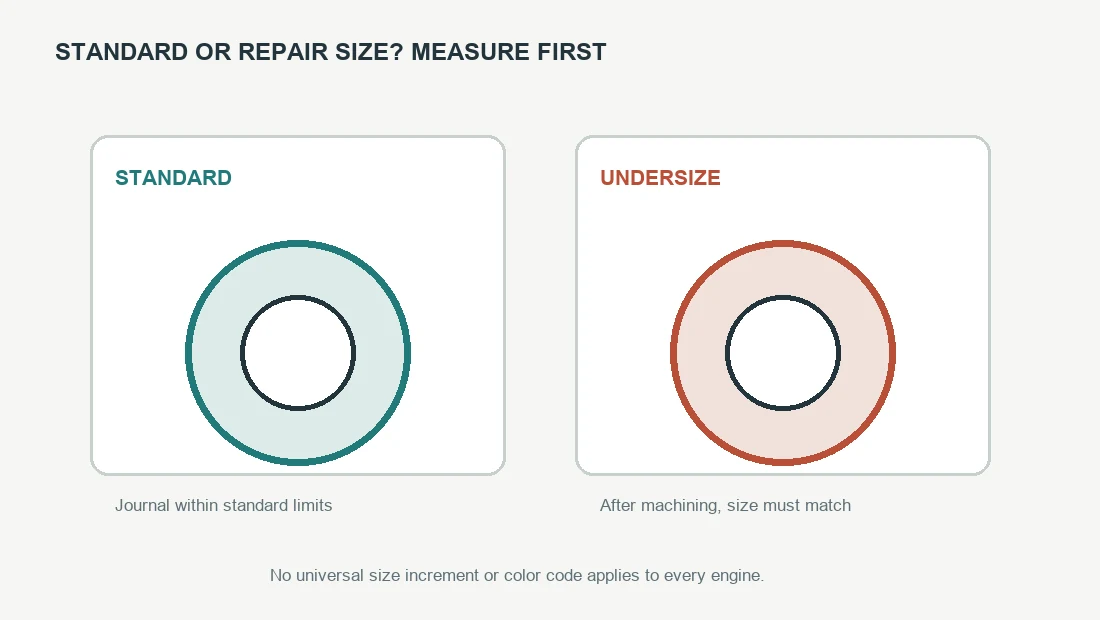
In most catalogs, “standard” refers to a journal in the engine’s standard dimensional range. A machined crankshaft may call for a repair-size bearing. Journal diameter means the measured diameter of the surface the bearing runs on. Check the engine specification beside the catalog listing, because the size labels and steps are not universal.
“Undersize” doesn’t mean “choose the next smaller number” for every engine. Catalogs can express the nominal difference in different ways, while a color mark on one application may not carry across to another. Check the current OE or bearing-maker catalog for the exact engine and size class.
|
Information available |
What it tells the buyer |
Next step |
|
Old shell marking |
What may have been installed |
Compare it with repair history and journal measurements |
|
Engine code |
Narrows the catalog application |
Confirm bearing position and full reference |
|
Final journal readings |
Describes the crankshaft after machining |
Compare each reading with that engine’s service limits |
|
Package label |
Identifies listed contents or size |
Verify set coverage and application before ordering |
Do not select from the old shell alone
Do not throw out the old shells before recording their marks. They show what came out of the engine, although a previous repair or misplaced shell can make that history misleading. File the marks with the repair notes and use fresh journal readings for the new selection.
A removed shell may say standard even though the crankshaft has since been ground. Its mark describes the old part. The new order must follow the post-machining measurement.
Know when a repair-size bearing may be needed
After grinding, measure again: the bearing has to fit the finished journal. Check the proposed repair size against the engine and bearing specification. The package label cannot tell the buyer what happened to this individual crankshaft.
Measure the crankshaft and confirm oil clearance
Place the shop’s finished measurements alongside the identified engine’s service page. A chart for another engine, even one with similar figures, cannot close this order. Mark the size pending until both records are available.
Bearing size selection still has to be checked after assembly. Oil clearance is the space between the journal and bearing surface, measured by the method in the engine service procedure. The box label says nothing about the clearance achieved in this engine.
Measure each journal using the correct procedure
Ask the shop for a position-by-position sheet, not one average diameter. The engine manual states where to measure and what taper or out-of-round is permitted. If the journal is polished or ground after that sheet was made, ask for a new sheet.
An average can hide a journal that falls outside its limit. Keep the readings by position, and ask the rebuilder to resolve any borderline measurement before a bearing order goes ahead. Main and rod positions belong on separate lines.
If seven journals pass and one fails, the average can still look acceptable. Keep the eight results separate and have the rebuilder resolve the failed position before the set is selected.
Use the correct service limit and clearance procedure
After selecting the shell, check assembled oil clearance against the factory procedure for this engine. A figure from a similar engine is not an acceptable substitute, however close it looks.
When a journal is beyond its service limit, stop on the crankshaft question. A different bearing isn’t a repair plan for an unapproved journal.
Check the assembled result
The rebuilder verifies assembled clearance using the engine’s procedure. Add the selected size class and catalog application to the order record. A note that says “it looked right” will not help if the engine later needs to be opened again.
Match the complete bearing application
Only after the finished journal establishes a size class should the buyer settle the catalog reference. Match the OE number, engine code and main-or-rod position, then verify quantity and set coverage. Packages with similar names can contain different positions.
Use factory grade or color marks only with the procedure for this engine in hand. Neither a familiar-looking shell nor a familiar box proves fit. The order should also say whether it contains bearings alone or other rebuild parts.
The ACES and PIES data standards give trading partners a shared structure for product and application records. That helps organize a catalog comparison; it does not establish whether a measured crankshaft falls within its engine’s limits.
Prepare a bearing verification sheet for the order
Keep the size decision on one order sheet. Include:
- Vehicle model, year, market, and engine code.
- Bearing position: main or connecting rod.
- OE reference and any confirmed replacement number.
- Journal measurements and the source of those measurements.
- Crankshaft condition and any machining history.
- Required size class and the catalog or service data used to select it.
- Set contents, quantity, and any position-specific grade or marking.
- The person or shop that confirmed the measured application.
The order sheet should show whether fit was checked against finished measurements or merely cross-referenced in a catalog. If another crankshaft repair follows, record the new dimensions and revisit the bearing size rather than reusing the old answer.
The engine code may be settled while grinding is still under way. In that case, leave only the size pending. When the final measurements arrive, compare them with service data and request the matching catalog reference.
About YBAOH’s Hyundai and Kia engine-bearing range
Bearings sit in YBAOH‘s Hyundai and Kia engine and repair-parts range. Company background is on the About us page. The Hyundai and Kia engine-parts category is the closest product group for a bearing inquiry; it does not establish which size fits a particular crankshaft. The separate 20910-2GU01 gasket-kit material guide covers another rebuild decision.
Frequently asked questions
Can I order standard bearings from the marks on the old shells?
The mark only describes the shell that came out. Keep it with the repair notes, but use the finished journal readings and engine service data to choose the replacement.
Does an undersize bearing fit every reground crankshaft?
No universal repair size fits every reground crankshaft. Match the finished journal dimensions to the specification for that engine and bearing.
Are main and connecting-rod bearing sets interchangeable?
No. Main and rod bearings serve different positions. Check the engine code, full reference and set contents before the order is released.
Confirm the measured size before ordering
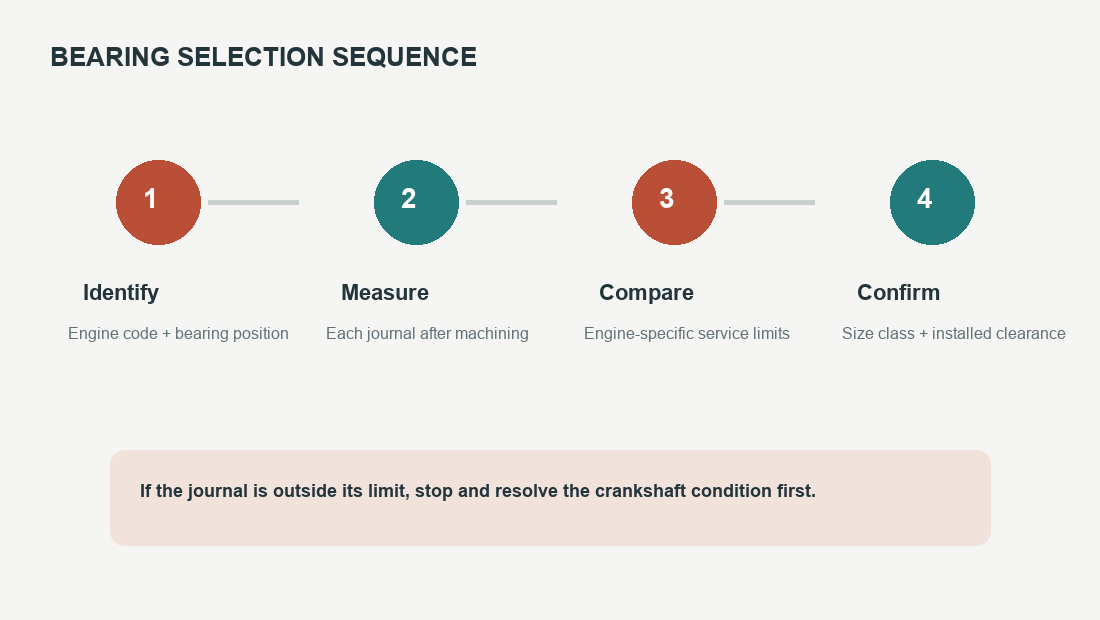
The useful sequence is short: engine and position, final journal readings, service limits, then the catalog reference and package. For a YBAOH range inquiry, send the engine code, OE number, bearing position, readings and machining history through contact the parts team.