

How to Prevent Upper and Lower Radiator Hose Mix Ups in Hyundai Parts Orders
Order verification sequence
An upper radiator hose and a lower radiator hose are easy to distinguish on an installed vehicle. They are less obvious when a buyer sees two black molded hoses in separate catalog photographs. A parts counter that relies on “radiator hose for Hyundai” may order the wrong side, even when the model and year appear correct. A distributor then faces a return, a stopped repair and a carton that may be hard to resell.
The safest order record identifies the hose by its actual location, OE reference and connection geometry. Vehicle details establish the application; photographs and measurements confirm the physical part. This article sets out a repeatable check for workshops and wholesale buyers that handle several Hyundai or Kia models at once.
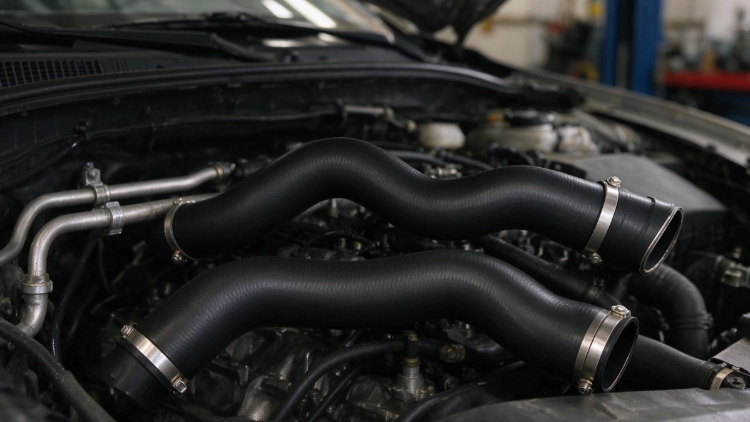
Key takeaways for the order:
- Identify the leaking component and its upper or lower location.
- Match the OE reference and complete molded shape.
- Check the sample, carton label and incoming stock.
Confirm the hose that needs replacement
Start at the vehicle. Record the model, model year, engine, market and VIN where available. The NHTSA VIN decoder can help establish basic identity for US-market vehicles, though the actual parts reference still needs a vehicle catalog. Ask the technician to identify the failed hose on the vehicle, not only by the name used in a service message. Photograph its complete route from one connection to the other. Include both ends, any branches, molded bends, protective sleeves and clip positions. A close-up of a crack alone cannot identify the replacement shape.
Upper and lower describe location, not interchangeability
Hose position is the hose’s location and route within the vehicle’s cooling circuit. The label upper or lower alone does not prove that two catalog references can be exchanged.
An upper hose normally joins the hot outlet side of the engine to the upper radiator connection, while a lower hose serves the return side of the circuit. The precise routing varies with the vehicle. Some designs have branches or additional fittings, so a buyer should follow the actual hose and consult the vehicle parts diagram. “Upper” and “lower” are useful labels, but they are not substitutes for an OE number.
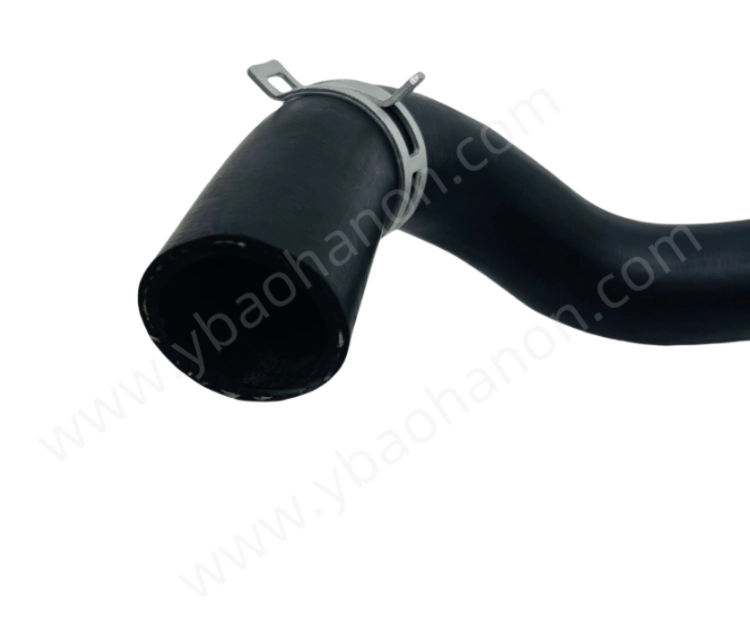
The site lists 25412-25000 HOSE-RADIATOR LOWER as a cooling-system product with OE number 25412-25000. That listing identifies the part as a lower hose. It does not establish compatibility with every Hyundai or Kia model, and it does not make a similarly shaped upper hose an acceptable substitute.
Diagnose the source of the leak first
Coolant on a hose does not prove that the hose wall has failed. Fluid can run down from a loose clamp, radiator neck, thermostat housing or another connection. NHTSA’s cooling-system advice calls for checking the system for leaks. Clean and inspect the area under appropriate workshop conditions, then record where the leak begins. If the connection neck is damaged, replacing only the hose may leave the original fault in place. A buyer who receives the correct hose for the wrong diagnosis still has an unresolved repair.
For a wholesale replenishment order, the diagnosis step becomes a demand check: identify the vehicle population and confirmed references behind the sales history. A large order based only on a generic “radiator hose” sales category can hide several distinct part numbers. Separate upper, lower and branch variants before quantities are combined.
Compare the OE number and physical geometry
Use the vehicle parts catalog to obtain the original hose reference. Note any supersession and the source of that information. Compare the proposed supplier number with the OE reference in writing. A part number appearing in a product title should be treated as a candidate until the supplier confirms the precise application. The buyer should preserve the original number on the purchase order even if a supported replacement number is quoted.
OE reference is the vehicle maker’s part identifier for the application under review. Supersession is a documented replacement of one reference by another; it should be confirmed in current parts data, not inferred from a similar appearance.
Check each end and every branch
Lay out the removed hose or use a complete service photograph. Compare the inside diameter and shape of each end, the sequence of bends, overall reach, and the positions of branches or molded attachments. The two ends may differ. Turning a hose around to make it reach can put a bend against a moving component or force a connection at the wrong angle. A hose that fits both necks only after being stretched or twisted has not passed the fit check.
Do not infer material grade, temperature rating or pressure capability from appearance. Ask the supplier for the applicable specification when those characteristics matter to the purchasing decision. The order line should state what has been confirmed and what still needs checking, rather than replacing missing evidence with a broad claim of “OE quality.”
Check routing against neighboring parts
A molded hose is designed to follow a route through a crowded engine bay. Use the vehicle’s service information to confirm clearance around belts, fans, exhaust components and brackets. Note whether protective sleeves or clips are attached to the original assembly and whether they are included in the proposed replacement. A visually similar hose may have a different bend that changes clearance after installation.
Photographs help the supplier compare geometry, but scale can be misleading. Put a measuring tape or a known reference beside the hose when dimensions are disputed. Include a view of the ends, a top view of the full shape and a side view of branch angles. When an old hose has swollen or deformed, use catalog or drawing dimensions to settle the comparison rather than trusting its current shape alone.
Write a purchase order that can be checked
Create separate lines for every hose reference. A useful line includes vehicle identity, hose position, OE number, supplier number, quantity and packaging requirements. Add a drawing or photograph reference when the same vehicle family has several similar hoses. If the supplier offers a cross-reference, record who confirmed it and on what application data. A buyer should not accept an unexplained change of suffix between quote and invoice.
For example, a workshop may request a lower hose while a stock list offers only an upper-hose item for the same model name. The buyer should hold that line, photograph the removed hose and verify its OE number. Sending an upper hose because the model matches would turn a catalog ambiguity into a repair delay. This is an illustrative ordering case, not a confirmed application for a named vehicle.
|
Order field |
Buyer record |
Supplier confirmation |
|
Vehicle |
Model, year, engine, market and VIN when available |
Exact application or unresolved variation |
|
Position |
Upper, lower or branch location |
Same description on quote and label |
|
Reference |
OE number and source |
Offered number and supported supersession |
|
Shape |
Ends, bends, branches and attachments |
Drawing or photographs of supplied part |
|
Supply |
Quantity, inner pack and carton label |
Pack count and final label text |
The 25412-25000 lower-hose listing states 10 pieces per box. Confirm that quantity in the current quote before calculating cartons. It applies to the listing, not automatically to other hose numbers or custom packing. A mixed shipment needs clear inner labels so a warehouse worker does not put an upper hose into the lower-hose bin.
Inspect samples and incoming cartons
For a new part number or a large import order, approve a sample against the vehicle or a verified original component before committing to full quantity. Record photographs of the approved sample, the label and the measured features that separate it from neighboring references. Do not use a successful sample to approve a later shipment without checking that the production and packing follow the same specification.
At receipt, compare the carton label and inner pack with the purchase order. Select units from different cartons if the order is large. Check the molded shape, branches and ends against the approved reference. Look for crushing or permanent kinks caused by packing. Keep any mismatched or damaged hose separate, with the carton number and photographs, so the supplier can investigate the correct shipment line.
For example, one carton may contain the approved lower hose while another has a branch in a different position. A carton-by-carton check keeps the second variant out of the approved stock bin and gives the supplier a traceable discrepancy.
Receiving checks also protect the distributor’s catalog. If a wrong hose is entered under the correct stock code, every later sale can repeat the error. Correct the item record and the physical shelf label together. Do not quietly relabel a part as another application without a verified cross-reference.
Put verified parts into the catalog
The YBAOH website presents a broader cooling-system product range that buyers can use to locate candidate references. The site’s upper radiator hose article addresses hose failure and maintenance. The ordering task is narrower: identify the exact hose on the vehicle, verify the reference and shape, and make those details visible on the quote and carton.
The About Us page provides supplier context. A buyer can send the checked part reference and photos through the Contact Us page when a catalog match still needs confirmation.
A good hose order can be checked at three points: before quoting, before packing and when cartons arrive. The vehicle record and OE number start the decision. Geometry, branches and labels finish it. When any of those checks remains open, hold that order line for clarification instead of allowing a model-name guess to travel through the supply chain.
FAQ
Can an upper radiator hose be used as a lower hose?
Only if verified parts data explicitly identifies the same part for both positions on the specific vehicle. The words upper and lower normally describe different routes. A similar diameter or bend is not enough evidence to substitute one for the other.
Is the OE number enough to order a hose in bulk?
It is the primary reference, but application changes, supersessions and catalog errors still need attention. Confirm the vehicle details and compare the physical shape, especially when stocking several production years or markets.
What should a buyer photograph for a hose inquiry?
Photograph the complete hose route on the vehicle, both ends, any branch and clip position, plus the old part number if visible. Add a scale reference for disputed dimensions and keep the images with the purchase order.


