
How to Verify Hyundai Alternator Fitment Before Ordering
A quote for an Elantra alternator may have a price, a photo and a part number, yet still leave me unable to release the order. The model and year can cover different engines, build dates and markets. A front photo shows the pulley but often hides the plug. Those missing details become a return for a distributor or a stalled repair for a workshop.
I first jot down the vehicle info along with which catalog row was used for it in the process of preparing a quote. Lastly I compare the OE reference, wiring connection and physical layout of offered unit. If the actual plug or pulley is not interchangeable, I would ask the supplier to justify its cross reference prior to acceptance.
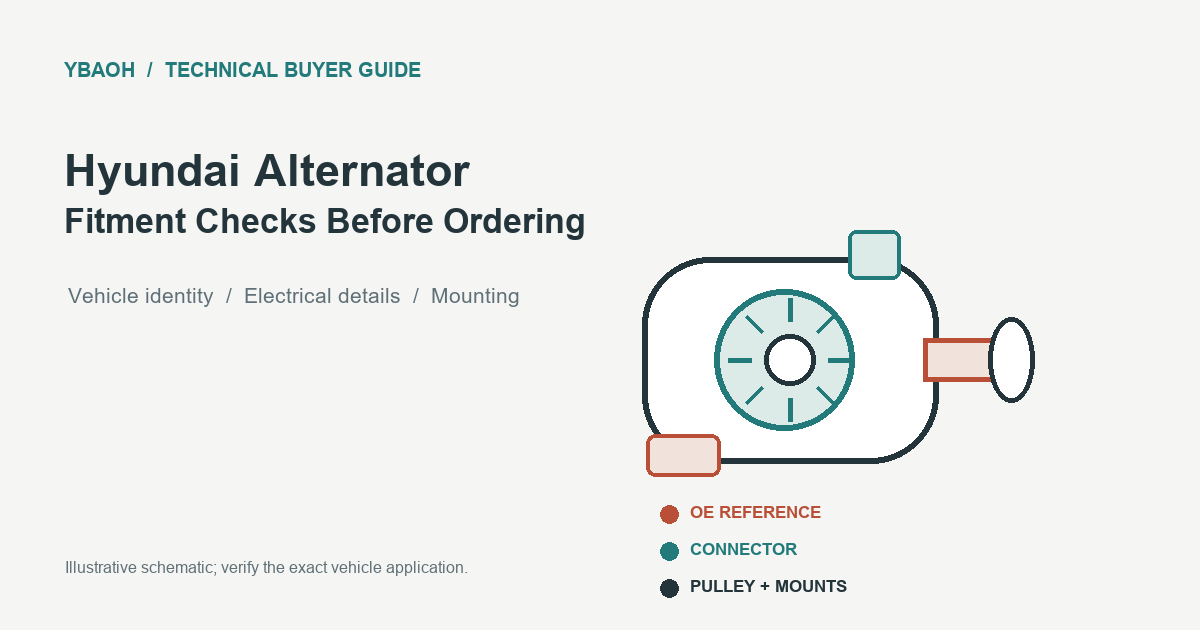
Key takeaways before placing the order: Supply year engine and market; where applicable, build date if a production change is involved. That’s the OE reference, then check out the regulator and connector at mount face & pulley on this proposed unit. Knowing the decoded VIN describes it and not an alternator that fits in its place..
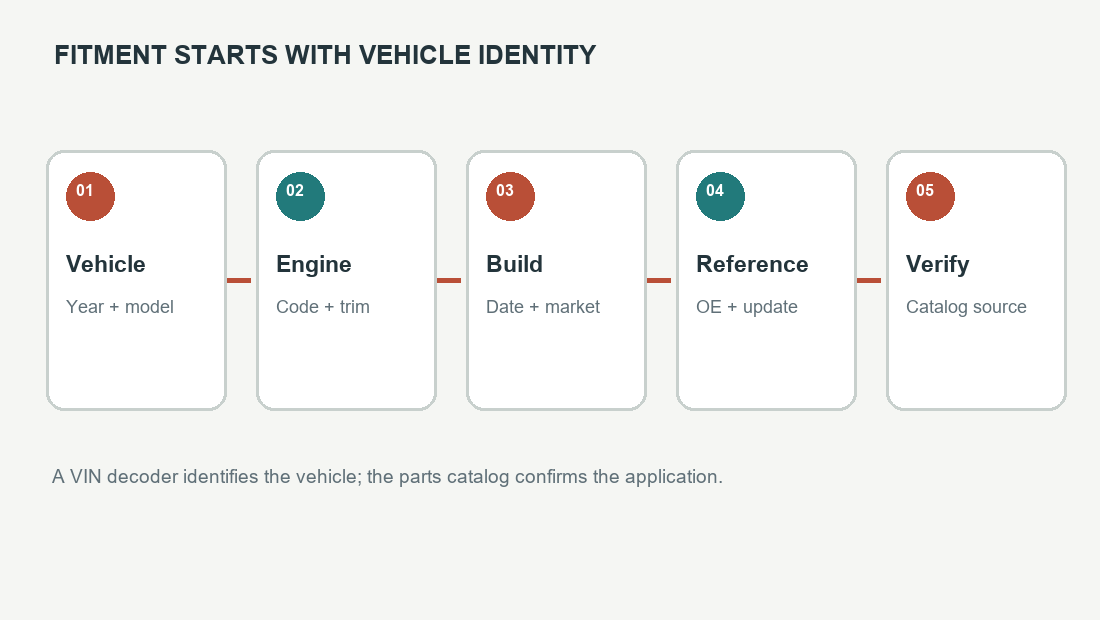
Start with the exact vehicle, not just “Hyundai”
Type “Hyundai alternator” into a parts search and you’ll get candidates. The application notes decide which row applies. Engine, build period and market can change the unit within one model line; the title and thumbnail usually don’t say enough.
Record the vehicle application
Week of the year, engine code, trim and market. If the vehicle was built during a model change or production period, enter its build date. Before making the label unreadable in connection with removal, photograph or videotape the installed units plug and pulley. The unit on the car may have been previously installed during an earlier repair, so remember that.
The NHTSA VIN Decoder helps check U.S. vehicle identity. It doesn’t give an alternator interchange or OE replacement. Enter the decoded vehicle details in the parts catalog to continue the fitment check.
Separate model identity from part application
What is more important than a category general title? The catalog note. The application should identify the engine and production range or point to the specific covered application. Because hybrids and conventional models will likely use separate charging hardware. The inquiry remains open if the seller failed to confirm that you matched their catalog. The inquiry remains open if the seller cannot demonstrate a catalog match.
“Fits Hyundai Elantra” leaves too much unsaid. Store the engine, production range and catalog source with the part number. The next salesperson can see which Elantra the record covers instead of repeating the search from scratch.
Detailing which engine, build range and market a part covers is done in the application row. In fact, two rows under a single model year are often available with nothing but an engine code or production date separating them. Look up the vehicle facts encoded in a VIN, and then map them to good catalog row. I guess one saving grace of that choice is: within the quote, save why.
Match the OE reference and its replacement history
The OE reference is more useful than a front-view photo. Read it from the removed unit where possible and search it in a current catalog. If the number has a supersession, the catalog should connect that replacement to the same engine and production range.
But the old label isn’t a final answer. A previous repair may have changed the unit, and one online listing may group multiple applications together. When the number conflicts with vehicle data, hold the quote and find the reason.
ACES and PIES data standards give trading partners a consistent way to exchange application and product data. That helps with comparing listings, but the format cannot resolve a particular car’s fitment for you. Check that the selected application and part reference agree.
Without an OE number, send the complete vehicle record and ask which catalog row supports the supplier’s choice. Save the row reference with the quote. When catalogs disagree, find the engine, build-range or supersession difference before price becomes the deciding factor.
|
Evidence at hand |
What it can establish |
What remains to check |
|
Model and year |
A starting vehicle range |
Engine, build date, market, and catalog coverage |
|
VIN details |
Vehicle identity for supported records |
Alternator interchange and OE reference |
|
Number on the old unit |
The reference currently fitted |
Prior replacement, supersession, and application match |
|
Catalog application |
Listed vehicle coverage |
Connector, electrical specification, and physical fit |
For stock replenishment, record the catalog source and the date of the application check beside the part number. Catalog data can change; a note that says only “fits Elantra” will not help the next buyer tell which row was approved.
For example, an OE number on the old unit may return a newer replacement number. Before updating the stock record, check that the catalog’s supersession applies to the same engine and build range. A number match without that application link leaves the fitment question open.
Check the electrical specification
Bolt holes lining up is only half the battle of a fitment check. A unit with the same type is able to have a unique regulator or terminal arrangement. I would compare those details and its output rating with the charging spec of the vehicle before I call it a match. That data, along with its output rating would be compared to the vehicle’s charging spec before I even (in my mind) called it a match.
Read the output figure with the test conditions indicated by the manufacturer; then, check if a regulator was listed for use in this catalog application. But if the vehicle’s controls or wiring are not compatible with that version, a higher rating can be significant to this order. That rating is meaningless here because the vehicle’s controls or wiring for that variant (and perhaps others) don’t fit, too.
Compare output and regulator details
If more output is desired, then require reviewing of wiring & battery as well as control system and electrical load. The start is a defined regulator and output in the catalog. Mention why another unit is under consideration for this vehicle and check that alteration before quoting it as an option. Note why an alternative unit is being explored for this vehicle and have that amendment approved before offering it as a substitute.
Specify on the inquiry any accessories or charging wiring that has been changed and have a qualified technician involved. A factory-vehicle application may still recognize the original alternator, but can’t know how many times has been installed since then. The application written against the factory vehicle will see the original alternator, but cannot know what electrical work came later.
Inspect the connector and terminals
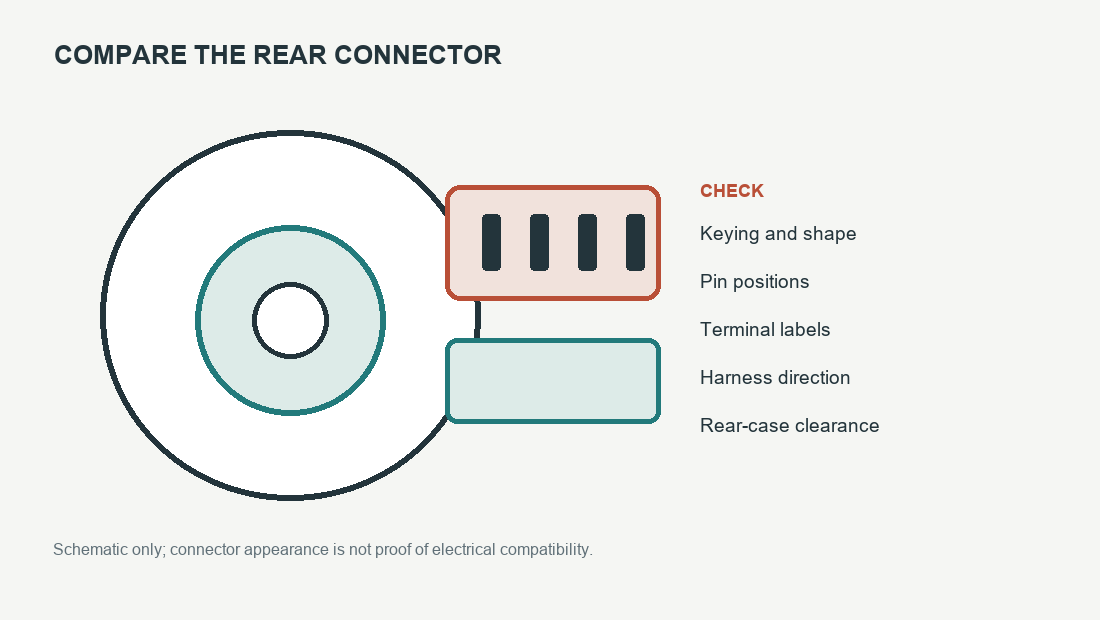
Easier to see the rear photo for comparison of plugs Do not only use outer shape but count terminals, and analyze keying, pin positions, where the harness route would be etc. The application of it thus needs to be solved if the only means possible for attaching a candidate is by changing vehicle wiring.
A front view for a listing keeps the connector and rear mount cloistered. Ask them to send a picture of that side and compare it against the applications data before you finalise your purchase order. Take a photo of this side and compare it with the record saved in application before releasing purchase order.
Check the mechanical fit before approving the order
With the side and rear views, one can verify mount spacing along with pulley offset as well as available space behind case. Instead of comparing them with a stand-alone alternator pulled off the car, compare with a drawing or catalog application? This older unit may itself have been replaced. Clocking, or the rear case positoon in relation to the mounts will dictate where its connector is located and be able to route wiring cleanly.
Mounting ears and clocking
I want the bolt spacing and ear thickness at the mounting face, along with the rear-case angle. The bolts can align while the connector hits a bracket or offers no space for harness. The bolts may align while connector points toward a bracket or doesn’t leave length for the harness.
It captures the small differences at the mounting face but otherwise more for overall length. For application dimensions, if available and inspect the contact surfaces and ear positions before deeming two housings interchangeable. Where possible, use application dimensions and examine the contact surfaces and ear positions before declaring two housings as interchangeable.
Pulley and belt alignment
The pulley check covers type, groove count, diameter and offset from the case. A belt running out of its intended plane can become noisy or wear at an edge. Do not assume the old pulley can simply be reused; where a transfer is permitted, follow the vehicle procedure with the specified tools.
Clearance and supplied hardware
Check the space around brackets and hoses before ordering. Ask the supplier exactly what the box contains: pulley, spacers and fasteners are not always included. Confirming this with the quote saves a repair from waiting for one missing fitting after the alternator arrives.
Fitment records for stock orders
For repeat orders, keep the OE reference and supersession, engine and build range, market, electrical details, mount and pulley information, and catalog source with the stock record. That record helps the next person handle an inquiry without repeating the first application check.
At intake, keep these fields together:
- Vehicle: year, engine, trim and market; add the build date near a production change.
- Reference: OE number from the installed unit and any catalog-confirmed replacement.
- Fit: regulator and output, connector, mounting points, pulley and clearance.
- Status: catalog source and check date, marked as confirmed or still unverified.
Keep confirmed applications apart from possible cross-references in the stock record. A trial fit on one vehicle supports that application, not every engine and year covered by a broad listing. Give another engine variant its own row and check its catalog application before approving repeat orders.
A buyer may send a number from an old unit or a phone picture with no vehicle record. Mark the missing year, engine, build range or market in the stock system and ask for it. That short exchange is a better basis for the order than treating the photo as fitment proof.
About YBAOH’s Hyundai and Kia parts range
Alternators sit in YBAOH‘s electrical range. Its Hyundai and Kia parts range also covers water pumps, pistons and rings, bearings, overhaul kits and cylinder gaskets. These are product categories a buyer can inquire about, while fitment for a particular car comes from the application catalog. Company details are on the About us page.
The Hyundai and Kia engine-parts category is a starting place for the inquiry. For the separate OE-versus-aftermarket choice, consult the Hyundai and Kia parts selection guide. Use the specific vehicle’s manual for service settings and installation procedure.
Frequently asked questions
Can I match a Hyundai alternator by model name alone?
No. Even one model year can have several engine or market versions. Identify the build range and catalog application first, then compare output, connector, mounts and pulley on the offered unit.
Does a VIN decoder tell me which alternator to buy?
For supported records, it establishes vehicle identity. Fitment comes later, when a parts catalog ties that vehicle to an OE reference and the relevant alternator row.
Can I replace the original alternator with a higher-output unit?
Possibly, but only after a technician reviews the regulator, wiring, terminals and vehicle control strategy. The output number alone is no reason to release a different alternator.
Make the fitment check before the order
Before releasing the order, put the vehicle record, OE reference, electrical specification and mounting notes together. Hold any unresolved application for checking. For a YBAOH inquiry, send the model year, engine code, market and OE number through contact the parts team.