

What Are the Common Symptoms of Incorrect Valve Clearance?
Have you ever noticed your car’s air conditioning struggling on a hot day, or the cabin refusing to warm up when winter hits? These frustrations often trace back to one small but critical component: the control valve inside your A/C compressor. When its internal clearance — the precise gap that allows the solenoid to move freely — drifts out of specification, everything changes. You feel it in comfort, fuel economy, and even repair bills. Today, let’s walk through exactly what happens when that clearance goes wrong, and more importantly, how you can fix it for good.
If you drive a Hyundai or Kia from the last decade, you have probably heard mechanics talk about compressor issues more often than you’d like. The truth is that most of those problems are not the compressor itself — they start with a failing control valve. I’ve been supplying automotive HVAC parts to workshops worldwide for years, and the story is always the same: owners chase expensive compressor replacements when a simple, perfectly engineered valve would have solved everything.
That’s where a company like YBAOH comes in. They specialize in OEM-quality control valves that match factory tolerances down to the micron. Mechanics trust them because every single piece leaves the line 100% tested for clearance, leakage, and durability under real-world temperature swings. No guesswork, no comebacks. If you want parts that install once and perform for another 150,000 miles, that’s the kind of supplier you keep bookmarked.
Most Common Symptoms You’ll Notice First
You don’t need a scan tool to spot a control valve with incorrect clearance. Your senses tell you long before the check-engine light does.
-
Weak or inconsistent cooling The compressor can’t vary its displacement properly. On a 30°C day the air blows barely cool at idle, then suddenly gets colder when you rev the engine. That erratic behavior comes from the valve either sticking slightly (clearance too tight) or leaking internally (clearance too loose).
-
Warm air when A/C is on max In many Hyundai and Kia models, a worn valve lets the compressor run at minimum stroke all the time. You end up with lukewarm vents no matter how low you set the temperature.
-
Unusual noises from the engine bay A clicking, buzzing, or light rattling from the compressor area is classic. Too-tight clearance makes the solenoid fight to move; too-loose clearance lets it flutter.
-
Higher fuel consumption When the valve can’t reduce displacement on light loads, the engine works harder than necessary. Owners often report 0.5–1 L/100 km extra without realizing the A/C system is the culprit.
-
Compressor clutch cycling too often The system pressures swing wildly because refrigerant flow is unstable. The clutch engages and disengages every few seconds — a sure way to shorten clutch life.
-
A/C warning light or diagnostic trouble codes Modern Hyundai and Kia ECUs monitor compressor current draw. Codes like P1463 (A/C compressor control valve circuit) or P1464 (performance issue) almost always point straight to the valve.
If two or more of these sound familiar, you are very likely looking at clearance problems inside the control valve.
Why Clearance Matters So Much in Modern Compressors
Today’s variable-displacement compressors (VS16, VS18, etc. found in most Hyundai/Kia cars) rely on an electronic solenoid valve to adjust swash-plate angle in milliseconds. The factory specifies an internal clearance measured in hundredths of a millimeter. Heat cycles, contaminated refrigerant, and poor oil quality gradually wear that gap.
Too tight → the solenoid binds → compressor stays in high-stroke mode → poor cooling at idle and excessive load on the engine.
Too loose → refrigerant leaks past the piston → compressor never reaches full capacity → weak cooling at highway speeds and premature internal wear.
Either way, the compressor itself takes the blame and gets replaced unnecessarily.
The Reliable Fix That Workshops Swear By
Instead of gambling on an unknown aftermarket valve or paying dealership prices, more and more technicians reach for precision replacements that match OE performance from day one.
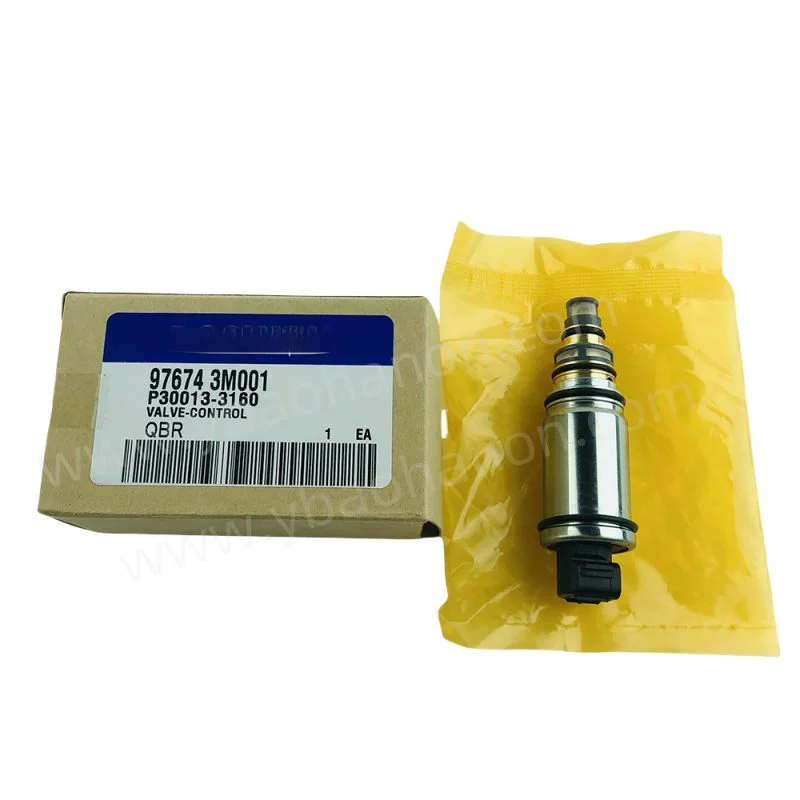
For many 2011–2019 Hyundai Elantra, Sonata, Santa Fe, and Kia Optima, Forte, Sorento models with 2.0L or 2.4L engines, the exact part you need is the 97674-3M001 VALVE-CONTROL. It arrives pre-calibrated, with high-temperature seals and a reinforced actuator that resists the thermal cycling these cars see every day.
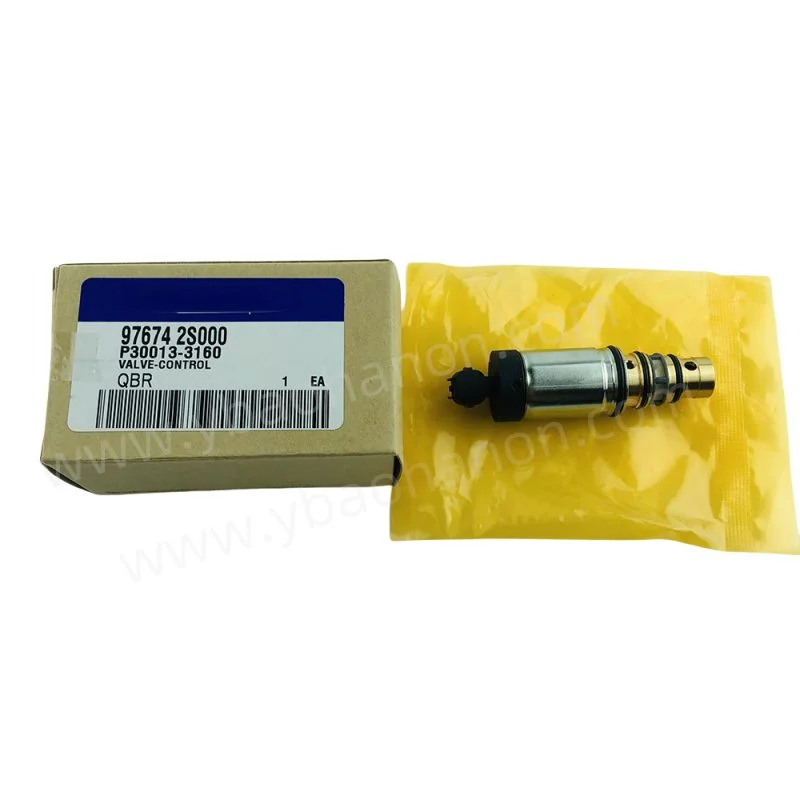
On newer platforms — think 2014–2017 Accent, Tucson, Genesis, or Kia K900 — the updated design is the 97674-2S000 VALVE-CONTROL. Engineers strengthened the solenoid housing and tightened manufacturing tolerances even further to handle higher system pressures without drifting clearance.
Both valves share the same advantages that make professional installers choose them repeatedly:
-
Clearance held to ±0.01 mm during production
-
100% end-of-line leak and function tested
-
Corrosion-resistant materials that survive contaminated refrigerant far longer than cheap copies
-
Perfect electrical connector fit — no more bent pins or intermittent codes
-
Direct drop-in installation; no modifications, no extra O-rings to source
The result? Cooling performance returns exactly to factory levels, noise disappears, fuel economy improves, and the new compressor you were dreading suddenly becomes unnecessary.
Prevention and Simple Maintenance Tips
Catch problems early and you’ll rarely need to replace anything.
-
Change cabin and engine air filters on schedule — dirty filters raise system pressure and accelerate valve wear.
-
Have the A/C system serviced every 3–4 years: evacuate, check for moisture, replace receiver-drier, and refill with fresh PAG oil. Clean oil keeps clearance stable.
-
Listen for changes. Any new buzz or weak cooling after a hot summer is your cue to scan for codes and check compressor clutch behavior.
-
When replacement time comes, insist on OEM-spec parts. The few extra dollars up front save hundreds later.
Get Back to Perfect Climate Control Today
If your Hyundai or Kia is showing any of the symptoms above, don’t wait for the compressor to grenade. A ten-minute valve swap at your local shop usually solves everything.
Need the correct part shipped fast? The team behind those two valves offers worldwide technical support, detailed installation guides, and genuine-part warranty coverage that actually gets honored.
Reach out today — one quick message can have you enjoying ice-cold air (or toasty heat) again by the weekend.
Email: sales@ybaohanon.com
WhatsApp/WeChat: +86 180 3022 6765
Website: www.ybaohanon.com
Your comfort is worth it.
Frequently Asked Questions
Q: Can a bad control valve damage the entire A/C compressor?
A: Yes, absolutely. If the valve sticks or leaks internally for too long, the compressor runs outside its designed parameters. Pistons and swash plate suffer accelerated wear, and eventually you face metal shavings throughout the system — a total loss. Replacing the valve early almost always saves the compressor.
Q: Will the symptoms come back if I just replace the valve with a cheap copy?
A: Very often, yes. Low-cost valves frequently use softer seals and looser tolerances. They may work for a few months, then clearance drifts again and you’re right back to weak cooling and noises. OEM-spec parts like 97674-3M001 and 97674-2S000 are built to the original drawings and tested the same way the factory does.
Q: My mechanic says I need a whole new compressor. Is he wrong?
A: Not necessarily wrong, but possibly premature. In at least 70% of the cases we see on 2011–2019 Hyundai/Kia models, swapping only the control valve restores perfect operation. Ask him to pull the valve first and measure current draw or back-pressure — the diagnosis takes minutes and can save you thousands.


